

 en
 English
 русский
 Español
 عربى

A firefighter opens a compartment door after a long working fire. Inside, the thermal imaging camera has slid under a halligan bar, the hose line is twisted into a knot, and a 20 kg SCBA cylinder is ...
READ MORE
Fire Apparatus Ladder Racks: Manual or Electric Mounting Guide for Pumpers
2026.10.02
Content
- 1 Start With the Ladder Complement, Not the Rack
- 2 Manual or Electric Actuation: Match the Mechanism to the Duty Cycle
- 3 Where the Rack Lives: Side, Tunnel, Overhead or Drop-Down
- 4 The Numbers Worth Writing Into the Specification
- 5 Aluminium, Steel and Coatings That Survive Road Salt
- 6 Fit-Up Traps That Appear After Delivery
- 7 A Short RFQ Checklist for Ladder Rack Suppliers
- 8 Questions Buyers Ask Before Ordering
- 9 What to Do Next
Specification meetings usually park the ladder rack near the bottom of the option sheet, a few lines above the license plate bracket. That is also why ladder racks become the complaint in year three: the rail is 200 mm short for a new 28 ft extension ladder, the latch needs two hands and a knee, or the overhead cradle sits higher than anyone on the crew can reach from the ground. Getting a fire apparatus ladder rack right is not a styling choice. It follows from three inputs - the ladder complement you are required to carry, the mounting real estate the body leaves free, and the way your crew actually pulls ladders at 03:00 in the rain.
Start With the Ladder Complement, Not the Rack
Conclusion first: dimension the rack from the ladders, and most of the decision turns into arithmetic rather than opinion. On a pumper, part of the set is not yours to choose - NFPA 1901 sets a minimum ground ladder complement of 115 ft for pumping apparatus, and the edition your department buys against decides which lengths count toward it. One workable example totals 123 ft: a 35 ft two-section extension, a 28 ft extension, 20 ft and 16 ft roof ladders, a 14 ft combination and a 10 ft attic ladder.
- 35 ft extension - 28%
- 28 ft extension - 23%
- 20 ft roof - 16%
- 16 ft roof - 13%
- 14 ft combination - 11%
- 10 ft attic - 8%
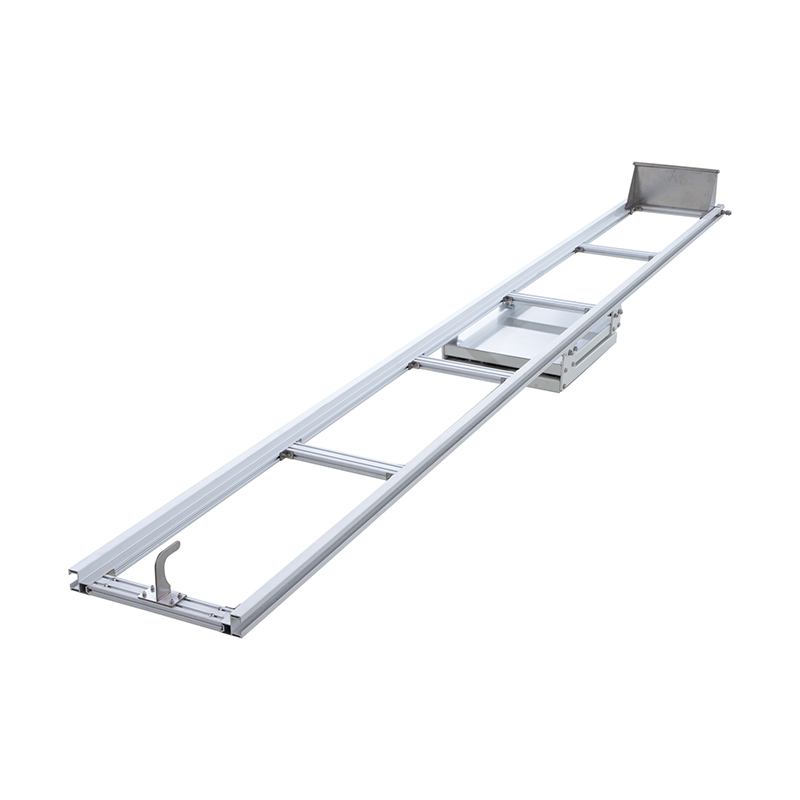
Two dimensions fall out of that list before anyone discusses actuators. Stowed length comes first: a two-section 24 ft extension stows at roughly 14 ft and a 35 ft two-section ladder close to 20 ft, so the longest ladder in the set sets the rail length. Allow 150 to 250 mm at each end for stops, latches and the clearance needed to lift a ladder out of the cradle. Weight comes second. A six-ladder complement commonly lands between 100 kg and 130 kg stowed, before wet webbing, ice and the chance that a firefighter pulls two ladders at once.
Manual or Electric Actuation: Match the Mechanism to the Duty Cycle
The practical test is simple: can a firefighter in gloves reach the latch and pull the ladder clear without climbing? If yes, a manual rack is the lower-risk answer. No wiring, no parasitic drain on the chassis batteries, no actuator to stall in freezing weather, and one obvious wear item in the latch. If the stowed position sits high, or the ladder is heavy enough that one-handed removal is unrealistic, electric actuation stops being a luxury.
Either way, insist on a manual release that works with the vehicle power off. A rack that cannot be opened after an electrical fault leaves the ladders stranded.
| Consideration | Manual rack | Electric rack |
|---|---|---|
| Release action | Latch opened by hand | Switch-driven lift or slide, hand release as backup |
| Added weight | Lowest | Actuator, brackets and reinforcement |
| Vehicle wiring | None | Power feed, switch and fusing |
| Cold weather | Independent of battery state | Slower when cold; manual override matters |
| Service points | Latches, stops, bushings | Actuator, switches, connectors |
| Best fit | Side and drop-down positions within reach | Overhead and high-side positions, heavy ladder sets |
On overhead and high-side positions, an electric rack is usually the first one worth pricing.
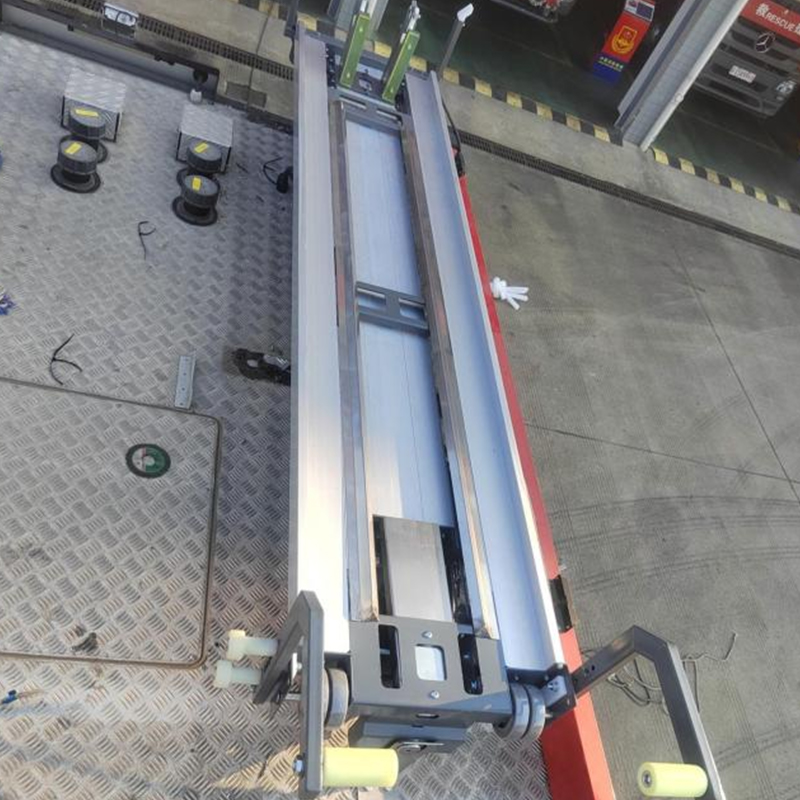
 Electric Fire Truck Ladder RacksDuring the process of retrieving and placing firefighting equipment, unfolding and retracting operations, our company has always pursued ways to reduce the physical ef...View Product →
Where the Rack Lives: Side, Tunnel, Overhead or Drop-Down
Body layout decides the mounting family before the rack itself is specified. Four arrangements cover most apparatus, and each trades reach against exposure.
- External side rack: bolts above the rear wheels or behind the cab, with the release point near five feet so one firefighter can pull a ladder without climbing. Road spray is the trade-off.
- Through-tunnel stowage: ladders slide into a tube inside the body with rear access. Weather-protected, but the crew walks to the back of the truck, and hosebeds or cross-lays can block the opening.
- Overhead or hydraulic rack: frees compartment space and keeps ladders off the working side, at the cost of overall height and an actuator.
- Drop-down cradle: the ladder travels high and arrives at chest height for removal. Best reach of the four, with the most mechanism to inspect.
Write the finished overall height into the specification and measure your station doors, including any apron slope. An overhead rack that clears by 50 mm on flat ground can touch with a full tank and a loaded hosebed.
Side and drop-down positions usually call for manual cradles, where the simplicity pays off across a long service life.
 Manual Fire Truck Ladder RacksThe vehicle ladder rack provides a fast and effective ladder lifting and lowering solution for various types of fire and rescue vehicles.View Product →
The Numbers Worth Writing Into the Specification
Entries such as "ladder rack, suitable" create change orders. Six lines remove most of the argument later.
- Stowed envelope: rail length and cradle opening for the longest ladder, plus 150 to 250 mm per end for stops and latches.
- Ladder profile: round or flat rungs and rail thickness both change the shape of the cradle.
- Rated load: the sum of stowed weights with a working margin; 1.5 times static weight is a reasonable planning baseline.
- Release effort: a latch one gloved hand can open, from the ground, with the rack loaded.
- Retention: ask how the rack was tested under braking, cornering and rough road input rather than assuming.
- Interface and finish: hole pitch and bracket feet that match the body framing, tolerances around plus or minus 2 mm on hole centres, stainless fasteners and isolating washers where aluminium meets steel.
Aluminium, Steel and Coatings That Survive Road Salt
A ladder rack lives in the worst place on the truck: low on the body, sprayed with brine for half the year, and rarely washed inside the cradle.
- Aluminium rails save weight and resist corrosion, but they corrode faster when bolted directly to steel brackets - isolate the joint.
- Steel rails are stiffer and cheaper, and depend on coating quality. Powder coat thickness means little if coverage is thin at cut edges and hole rims.
- Water pools in channel sections, so specify drain holes at the low point instead of closed pockets, and plan for grease that stays on slides and pivots.
Fit-Up Traps That Appear After Delivery
Most ladder rack problems are installation problems wearing a component costume.
- Bracket holes that miss the body sub-frame, which encourages someone to drill where they should not.
- Cradles aligned on an empty truck, so the ladders rattle once the body flexes under a full load.
- Latches that work on the bench and hang up once the rack is carrying weight.
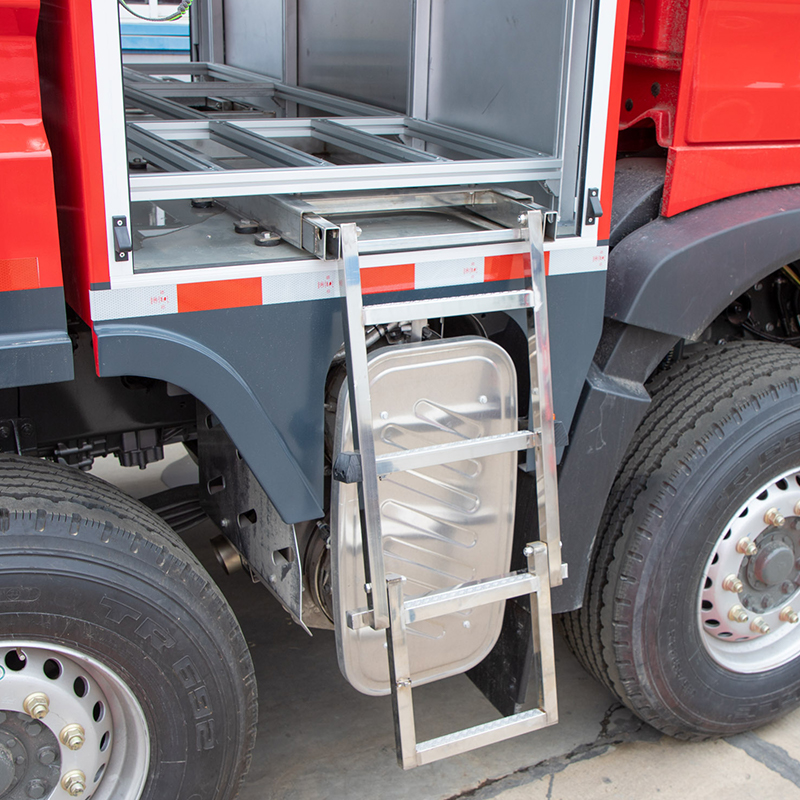
Fitting the rack and the surrounding hardware as one package prevents most of this. Boarding ladders, handrails and grab handles compete for the same 300 mm near the wheel arch, and it is far easier to settle mounting heights and stowed lengths on paper. Review our fire truck boarding ladders alongside the rack dimensions so reach, clearance and handhold positions are decided together, not in three separate orders.
 Fire Truck Aluminum Ladder HandrailThe fire truck ladder handrail is a safety protection device installed on both sides of the rear ladder or boarding ladder of the fire truck, specifically designed for...View Product →
A Short RFQ Checklist for Ladder Rack Suppliers
- List every ladder by length, type and stowed weight, and mark the longest.
- State the mounting family: side, tunnel, overhead or drop-down.
- Give the available rail length and the height above ground of the release point.
- Confirm the mounting interface: hole pitch, hole diameter and whether reinforcement plates are supplied.
- Ask for the load rating and how it was verified.
- Ask for the release effort and whether one person can operate it wearing gloves.
- Specify finish, fastener material and isolating hardware.
- For electric racks, request the wiring diagram, current draw, actuator ingress protection and the manual override procedure.
Questions Buyers Ask Before Ordering
Can a manual rack be converted to electric later?
Sometimes, but the conversion is rarely just a motor. Bracketry, mounting points and control wiring differ between the two versions, so raise the possibility during specification rather than after delivery.
What load should a rack be rated for?
Add the stowed weight of every ladder it will carry, then add margin for wet webbing, ice and the chance that a crew member pulls two ladders at once. A rack rated exactly at the dry ladder weight has no margin left for a January night.
How often should racks be inspected?
Latches, stops and bushings belong on the daily walk-around. Fasteners, coating damage and lubrication belong on the scheduled service after winter, and fasteners should be retorqued once the body has settled.
What to Do Next
Write the ladder list first, mark the longest stowed ladder, then choose the mounting family. Everything after that - manual or electric, rail length, load rating, finish - becomes a decision you can defend to a purchasing committee, and a rack your crew can open with one gloved hand.
If the same installation includes boarding ladders and handrails, read our guide on how to choose the right fire truck boarding ladder before the specification is released, so height and reach are settled across all the hardware at once.
Tianchang Jinlv Fire Equipment has manufactured ladder racks, boarding ladders, handrails and stowage systems for fire apparatus since 2010, with production covered by a GB/T 19001-2016 quality management system. Send your ladder list and body dimensions through the contact page and we will reply with the rack envelope, mounting interface and actuation options that fit your build.
News
-
-
Fire truck ladder racks are roof-mounted storage and deployment systems that hold ground ladders securely in transit and let firefighters lower them to the side or rear of the apparatus in seconds. ...
READ MORE -
Quick Answer The right fire truck boarding ladder is a fixed, upward-folding, or rotating step assembly mounted at the rear or side of the apparatus that gives firefighters a stable, non-slip surface ...
READ MORE -
When a fire apparatus rolls out of the station for a structure fire or a highway rescue, every bolt, hinge, and ladder surface is about to face heat, vibration, moisture, and rough handling. Some com...
READ MORE -
Two pumpers of the same model can feel like two different trucks on the same call. On the first, a firefighter reaches into a compartment, releases one latch with a gloved hand, and pulls a tray far ...
READ MORE -
Two minutes into a working fire, a crew stands in front of a locked steel security door with a crowbar that is too short to pull with both hands. Nothing about the tool is broken. It was simply speci...
READ MORE
Hey! Interested in staying in the loop? Sign up for our updates.
WE WON'T SPAM YOU, PINKY PROMISE.

Tianchang Jinlv Fire Equipment Co., Ltd.
Copyright © Tianchang Jinlv Fire Equipment Co., Ltd. All rights reserved. Custom Fire Truck Equipment Supplier Fire Apparatus Parts Factory
