

 en
en
 English
 русский
 Español
 عربى
عربى




Quick Answer The right fire fighting nozzle depends on three factors: the flow rate your pump can deliver, the pattern your crew needs on the fireground, and the thread standard your hose already us...
READ MORE
How to Choose the Right Fire Truck Boarding Ladder?
2026.08.10
Content
- 1 How to Choose the Right Fire Truck Boarding Ladder for Your Apparatus
- 2 Fixed vs Foldable Fire Truck Boarding Ladder: Which Is Better
- 3 Which Fire Truck Boarding Ladder Suits Limited Cab Access Space
- 4 What to Look for in a Fire Truck Boarding Ladder for Heavy-Duty Rescue Trucks
- 5 Why Material Choice Matters: Aluminum vs Stainless Steel Fire Truck Boarding Ladders
- 6 Choosing a Fire Truck Boarding Ladder Manufacturer and Supplier
Key Takeaway
The right fire truck boarding ladder comes down to matching the mounting style, ground clearance, and material to your truck class: fixed ladders suit trucks with no clearance limits, foldable and pull-out ladders suit low-clearance or off-road apparatus, and 304 stainless steel outlasts aluminum in coastal or high-salt environments. A qualified fire truck boarding ladder manufacturer will walk you through all three variables before recommending a part. The comparisons below cover each decision point in detail.
How to Choose the Right Fire Truck Boarding Ladder for Your Apparatus
A fire truck boarding ladder is the fixed or movable step system mounted at the rear or side of an apparatus that lets firefighters mount and dismount safely while wearing full turnout gear. Choosing the correct one is not just about fitting a bracket to a bumper. It requires matching three variables at once: the mounting location on the truck body, the ground clearance the apparatus needs while driving, and the load the ladder must carry, since a fully geared firefighter with SCBA can weigh well over 250 lbs including equipment.
Start by measuring the vertical rise from ground level to the first tread and the available depth behind the rear compartment. A ladder that is too shallow forces an awkward step angle, which slows dismounting during an emergency response. Next, decide whether the ladder needs to retract for off-road clearance or ground obstacles. Finally, confirm the tread surface is rated non-slip under wet and oily conditions, since most boarding happens directly after a call in rain or with hose water on the ground. A fire truck equipment manufacturer that documents these three specs on every model makes the comparison process far easier than working from photos alone.
250 lb+
Typical load a boarding ladder must support per step, firefighter plus gear
3
Common mounting styles: fixed, foldable, pull-out
2
Primary materials: lightweight aluminum alloy or 304 stainless steel
15 yrs
Manufacturing experience of established fire apparatus accessory suppliers
Fixed vs Foldable Fire Truck Boarding Ladder: Which Is Better
The most common comparison a department runs into is fixed versus foldable. A fixed fire truck boarding ladder is welded or bolted permanently in place, offering the simplest structure with no moving parts to service. It is the right call for engines and pumpers that always park with rear clearance to spare and rarely traverse rough terrain. A foldable boarding ladder, by contrast, hinges upward against the rear of the truck body when not in use, protecting it from road debris and restoring ground clearance for off-road or steep driveway access.
The trade-off is mechanical complexity. A folding ladder has hinge pins, a locking mechanism, and sometimes a spring-assist, all of which need periodic inspection. A fixed ladder has almost nothing to maintain beyond checking weld integrity and tread wear. Departments running daily calls in dense urban areas where trucks are rarely off-road tend to prefer fixed designs for their simplicity, while rural and wildland departments favor foldable or pull-out designs that keep the ladder tucked away during transit.
Fixed Boarding Ladder
- No moving parts to inspect or lubricate
- Lower long-term maintenance cost
- Best for flat station yards and paved routes
- Simple welded or bolted installation
VS
Foldable Boarding Ladder
- Restores ground clearance when stowed
- Protects treads from road debris in transit
- Suited to rural, off-road, and wildland routes
- Requires periodic hinge and lock inspection
Fire Truck Boarding Ladder Series for Rear and Side Mounting
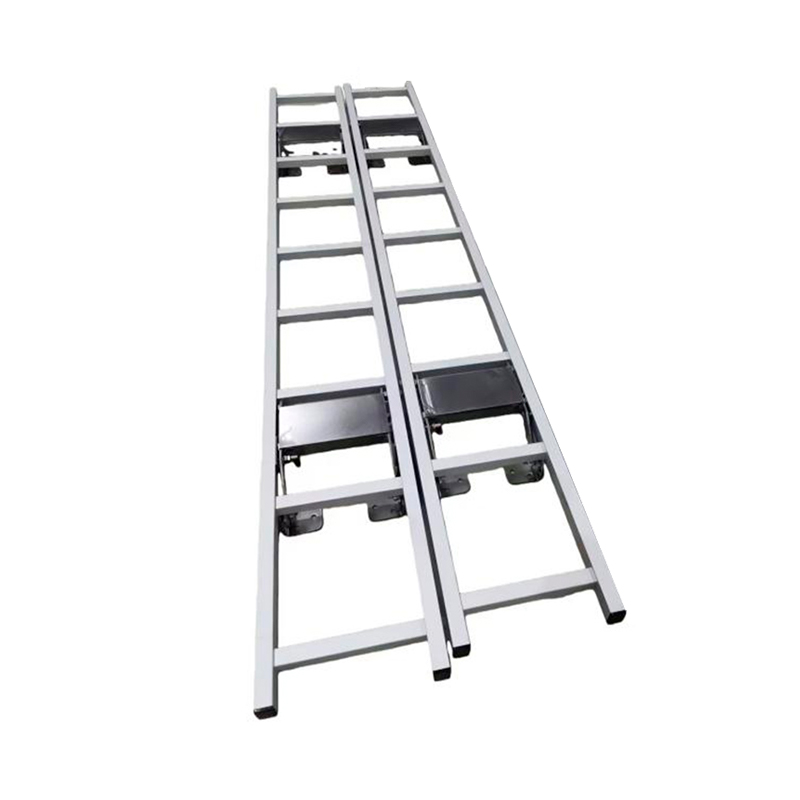
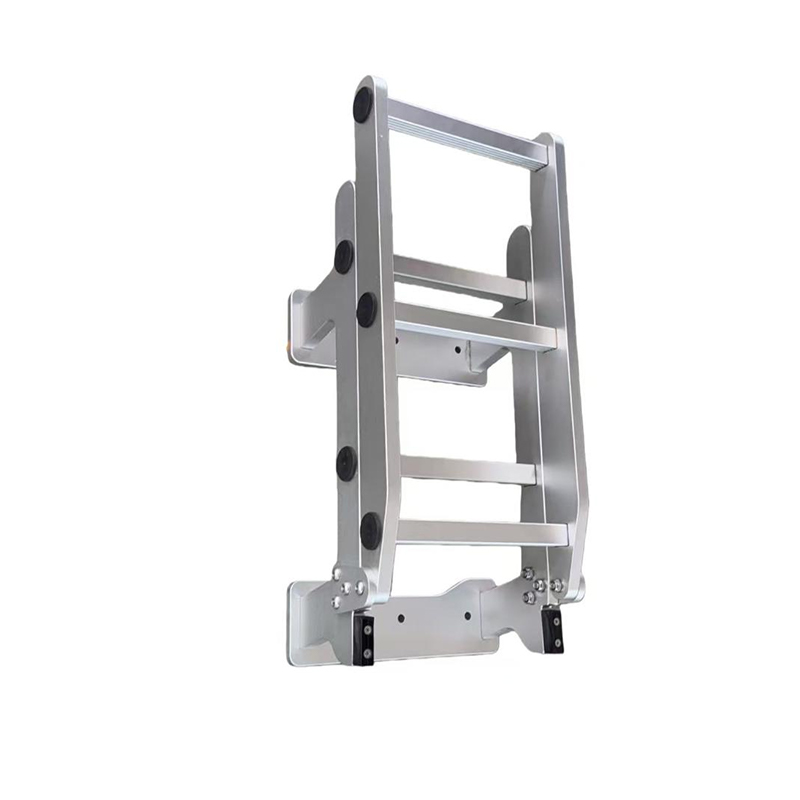
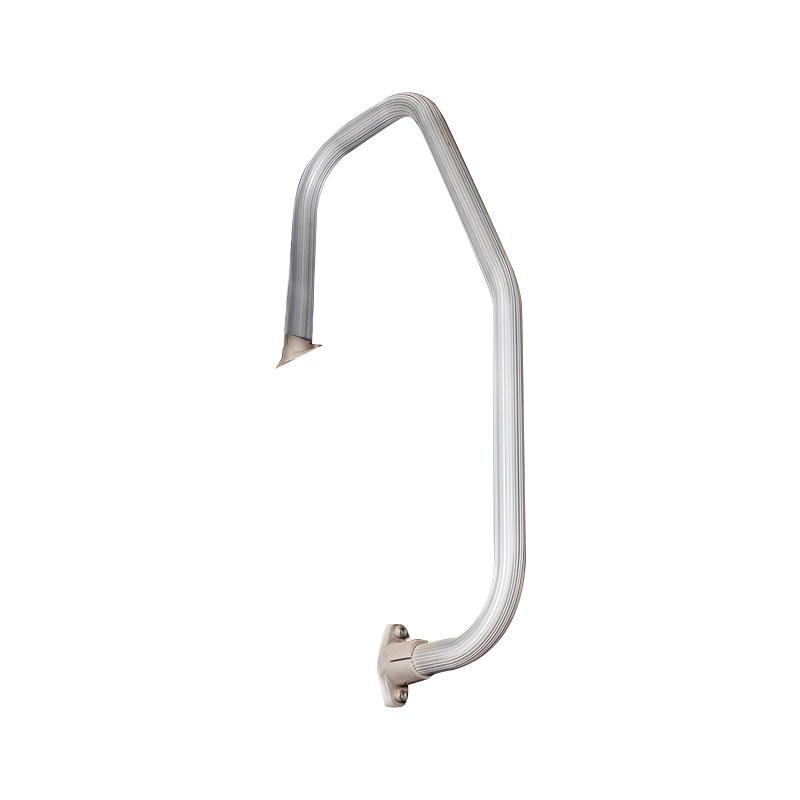
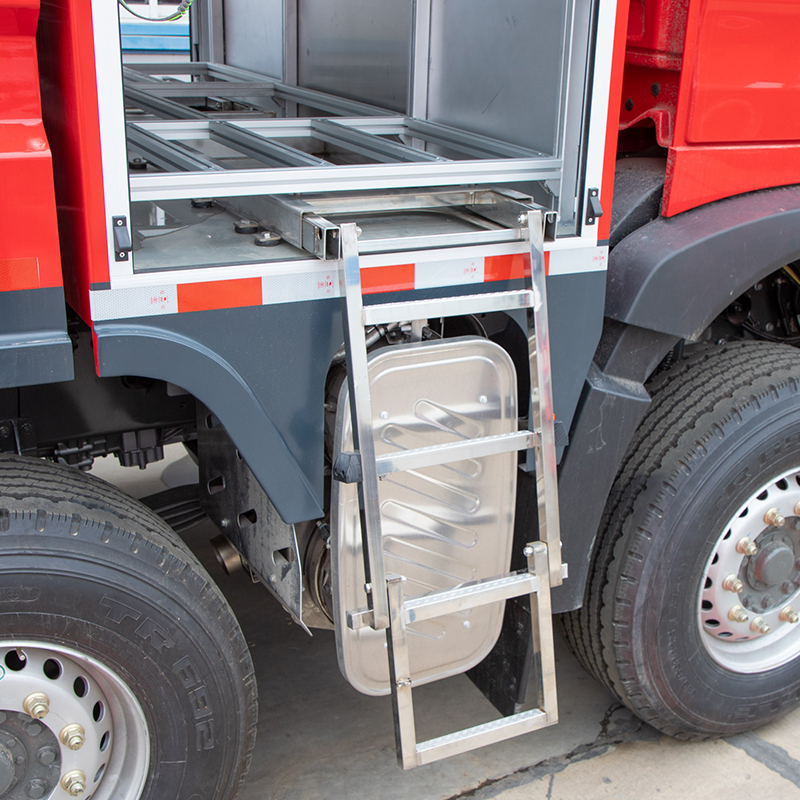
The lineup below shows fire truck boarding ladder configurations currently produced for rear and side mounting, spanning fixed, foldable, pull-out, and stainless steel builds.
Fire Truck Boarding Ladder Product Series
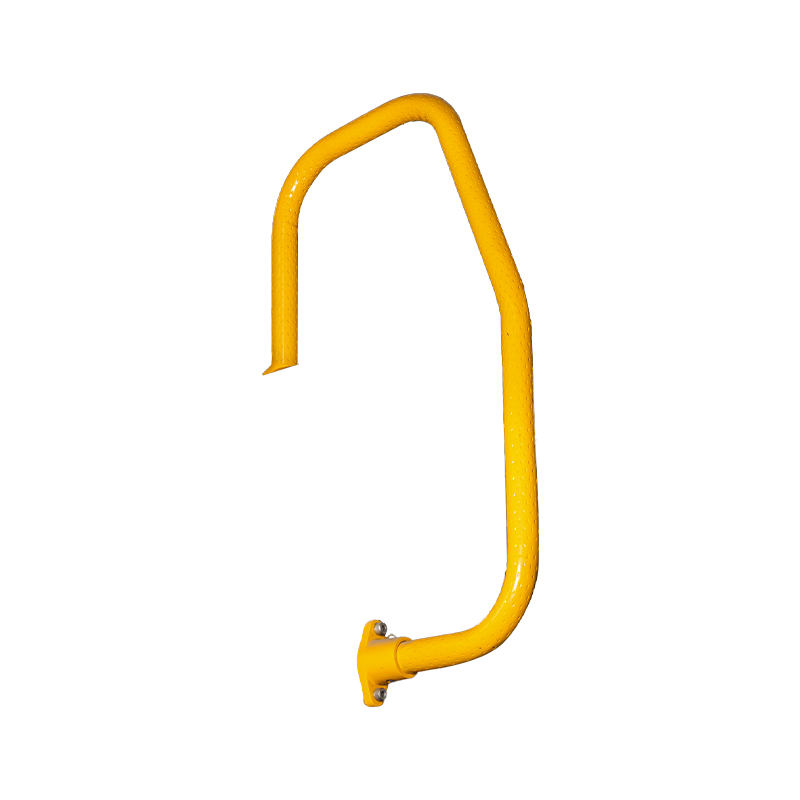
A range of fire truck access ladder configurations built for fixed, foldable, side or rear mount, and corrosion-resistant stainless steel applications on modern fire apparatus.
Which Fire Truck Boarding Ladder Suits Limited Cab Access Space
Not every apparatus has generous rear clearance. Rescue squads with rear-mounted generators, tankers with large discharge plumbing, and compact urban pumpers often leave very little room for a full-depth ladder. In these cases, a pull-out boarding ladder is usually the best fit, since it slides fully into a recessed housing when not needed and extends only when a firefighter needs to board. This keeps the rear of the truck clear for other equipment while still providing a stable step surface on demand.
Side-mounted boarding ladders solve a related problem for trucks where the rear is fully occupied by hose beds or ladder racks. Mounting a compact ladder at the crew cab door instead of the rear bumper gives firefighters a second access point without competing for space with stowage systems. Departments retrofitting an older apparatus with new fire truck equipment should measure both the rear and side envelope before ordering, since a pull-out or side-mount unit typically needs a slightly deeper recessed pocket than a simple fixed ladder.
Scenario
A tanker with a rear-mounted 500 gallon dump valve has almost no room for a fixed rear ladder. Fitting a pull-out boarding ladder in a recessed housing beside the valve gives the crew a stable step without interfering with discharge operations.
What to Look for in a Fire Truck Boarding Ladder for Heavy-Duty Rescue Trucks
Heavy rescue trucks carry more onboard equipment, more crew members boarding and dismounting per call, and often operate at accident scenes with debris on the ground. A boarding ladder for this duty class needs a wider tread than a standard engine ladder, a higher static load rating to account for two firefighters moving simultaneously during multi-casualty responses, and reinforced mounting brackets that can handle the vibration from onboard hydraulic tools and generators running nearby.
Corrosion resistance also matters more on rescue trucks, since they are frequently exposed to fuel spills, hydraulic fluid, and de-icing chemicals at highway accident scenes. A 304 stainless steel fire truck boarding ladder resists this chemical exposure significantly better than standard aluminum over a multi-year service life, even though aluminum remains lighter and is often preferred where total vehicle weight is a bigger constraint than chemical exposure.
| Feature | Standard Engine Duty | Heavy Rescue Duty |
| Tread Width | Standard single-step width | Wider tread for two-person boarding |
| Bracket Strength | Standard bolted bracket | Reinforced bracket for vibration loads |
| Preferred Material | Aluminum alloy for weight savings | 304 stainless steel for chemical exposure |
Why Material Choice Matters: Aluminum vs Stainless Steel Fire Truck Boarding Ladders
Material selection is often the deciding factor once mounting style is settled. Lightweight aluminum alloy keeps total vehicle weight down, which matters on apparatus already near their gross vehicle weight rating once water tanks and equipment are loaded. It also resists rust in dry climates and is easier to fabricate into folding or pull-out mechanisms since it is lighter to move by hand. The trade-off is that aluminum can pit or corrode faster than stainless steel when exposed to road salt, coastal air, or de-icing chemicals over several years.
304 stainless steel trades some weight savings for significantly better corrosion resistance and a harder wearing tread surface. Departments operating near coastlines, in regions that salt roads heavily in winter, or in industrial areas with airborne chemical exposure generally get a longer service life from stainless steel ladders even though they weigh more per unit. A fire truck boarding ladder supplier that offers both materials as standard options, rather than pushing a single default, gives departments the flexibility to match the ladder to their actual operating environment instead of a generic spec sheet.
Fast Reference: Matching Ladder Type to Your Apparatus
Urban engine with flat station yard access: fixed aluminum boarding ladder
Rural or wildland apparatus needing ground clearance: foldable boarding ladder
Tanker or rescue truck with rear obstructions: pull-out or side-mount ladder
Coastal or heavy road-salt regions: 304 stainless steel construction
Choosing a Fire Truck Boarding Ladder Manufacturer and Supplier
Once the design and material are settled, the remaining variable is who builds it. A fire truck boarding ladder manufacturer should offer documented load testing, custom sizing for non-standard compartment depths, and OEM or ODM production so the same specification can be reordered years later as fleet units are replaced. Tianchang Jinlv Fire Equipment Co., Ltd. is one example of this model in practice: a fire truck equipment manufacturer established in 2010 that has focused on fire protection accessories for 15 years, holds GB or T19001 to 2016 quality certification, and produces fixed, foldable, pull-out, aluminum, and 304 stainless steel boarding ladder configurations from its own factory with custom mounting brackets available on request.
Working with a single fire truck boarding ladder supplier for an entire fleet also simplifies long-term maintenance, since replacement treads, hinge kits, and brackets stay consistent across trucks purchased years apart. Departments building a new apparatus specification sheet should request drawings or dimensioned photos for each ladder configuration before ordering, confirm the manufacturer supports OEM integration with the truck body builder, and ask directly whether load testing data is available for the specific tread width and mounting bracket being quoted.
Fire truck boarding ladder selection is a short list of decisions done well: match the mounting style to your clearance needs, size the tread and bracket to your duty class, choose a material suited to your operating environment, and buy from a fire truck equipment manufacturer that can support the same part specification for the life of the apparatus.
News
-
-
Quick Answer The right fire truck boarding ladder is a fixed, upward-folding, or rotating step assembly mounted at the rear or side of the apparatus that gives firefighters a stable, non-slip surface ...
READ MORE -
Fire truck ladder racks are roof-mounted storage and deployment systems that hold ground ladders securely in transit and let firefighters lower them to the side or rear of the apparatus in seconds. ...
READ MORE -
A firefighter opens a compartment door after a long working fire. Inside, the thermal imaging camera has slid under a halligan bar, the hose line is twisted into a knot, and a 20 kg SCBA cylinder is ...
READ MORE -
Every firefighter has opened a compartment door after a rough response only to find nozzles, webbing, and wrenches piled on top of each other. In gloves and low light, with the pump running, that is ...
READ MORE -
Two pumpers of the same model can feel like two different trucks on the same call. On the first, a firefighter reaches into a compartment, releases one latch with a gloved hand, and pulls a tray far ...
READ MORE
Hey! Interested in staying in the loop? Sign up for our updates.
WE WON'T SPAM YOU, PINKY PROMISE.

Tianchang Jinlv Fire Equipment Co., Ltd.
Copyright © Tianchang Jinlv Fire Equipment Co., Ltd. All rights reserved. Custom Fire Truck Equipment Supplier Fire Apparatus Parts Factory
