

 en
 English
 русский
 Español
 عربى


Two minutes into a working fire, a crew stands in front of a locked steel security door with a crowbar that is too short to pull with both hands. Nothing about the tool is broken. It was simply speci...
READ MORE
Fire Truck Safety Handrail: Aluminum vs Iron, Mounting and Load Rules for Crews
2026.10.30
Content
- 1 What a Fire Truck Safety Handrail Is Actually Asked to Do
- 2 Aluminium or Iron? What the Two Standard Options Really Differ On
- 3 Sizing the Rail: Diameter, Wall Thickness and Standoff
- 4 Mounting, Interface and the Rest of the Access Path
- 5 What to Put in the Purchase Specification
- 6 Frequently Asked Questions
- 7 The Short Version
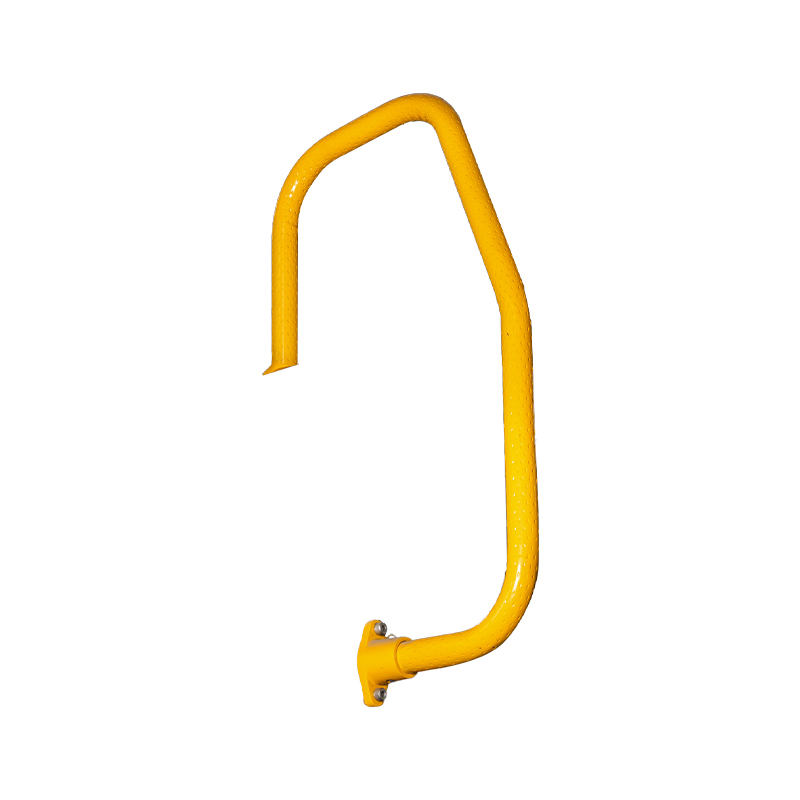
Three rungs up the rear of a pumper, a firefighter in wet gloves misses the grab and catches the handrail instead. Whether that rail holds was decided months earlier, at the bench: by tube wall thickness, bracket geometry, and how the fastener was tightened. A fire truck safety handrail is not trim. It is a load-bearing grip standing between a person and a fall from an apparatus, and it is one of the few components a crew touches on every single shift.
So here is the conclusion first: buy the handrail as a system — tube, bracket, fastener and standoff distance together — not as a length of pipe cut to size. In practice, rails rarely fail in the middle of the tube. They fail at the weld toe, at the bracket foot, and at the joint where painted steel meets aluminium and quietly starts to corrode.
What a Fire Truck Safety Handrail Is Actually Asked to Do
A handrail on a fire apparatus has four jobs, and they arrive in this order of importance:
- Carry a sudden, one-sided load. A crew member steps down with a tool in the other hand; the force arrives as a jolt, not a smooth pull.
- Keep a grip when the surface is wet, gloved or icy. Round tube of the right diameter does that. Flat bar and square section do not.
- Survive weather, road salt and repeated wash-down chemicals for the life of the vehicle.
- Stay tight. A rail that rotates five degrees under a hand still passes a visual inspection but no longer gives a confident hold.
Many specifications call for a rail to take a static load in the region of 200 lb (90 kg) applied at mid-span without permanent set, and for the fixing to carry a similar load in any direction. Treat those figures as a floor rather than a target, and confirm the exact requirement for your market before a drawing is signed off.
Aluminium or Iron? What the Two Standard Options Really Differ On
In this trade, an "iron" handrail is almost always painted or powder-coated carbon steel, while an aluminium handrail is normally a 6061-T6 or 6063-T5 extrusion. The names hide the real difference, which is how each one ages on a vehicle that is washed weekly and parked outdoors.
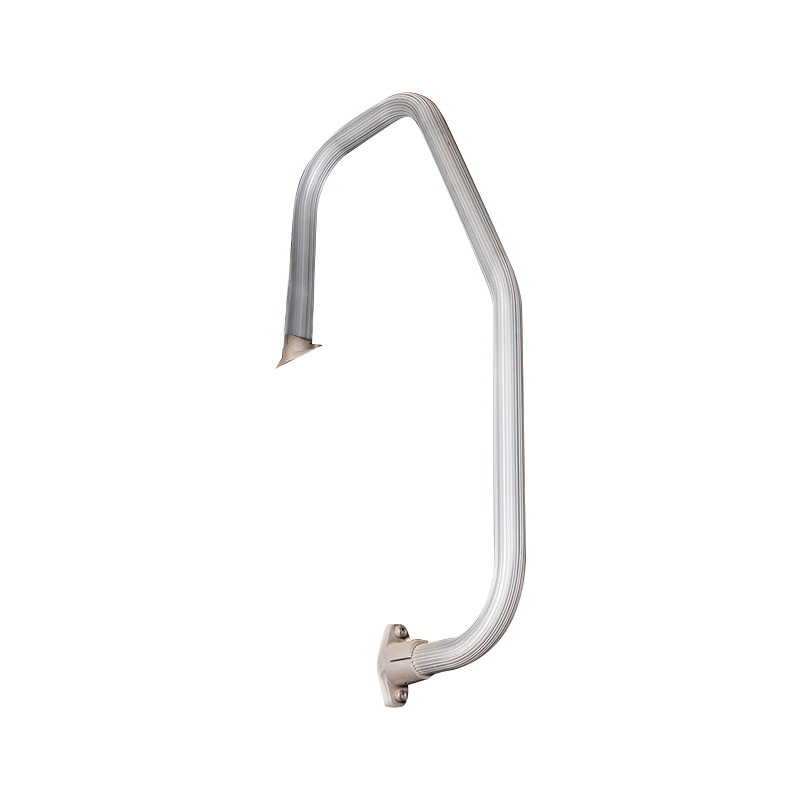
 Fire Truck Aluminum Ladder Handrail for Rear and Boarding LaddersAluminum alloy handrail for fire truck rear or boarding ladders, with customizable length and curvature; useful when comparing lightweight, rust-resistant rails for crew access.View Product →
Aluminium wins on weight and weather; steel wins on stiffness per section and on how easily a workshop can repair it. That trade-off is the whole decision, and the table below sets it out point by point.
| Factor | Aluminium alloy handrail | Painted carbon steel ("iron") handrail |
|---|---|---|
| Weight | Roughly one third the weight of a comparable steel rail, which makes it easier to lift into position on a ladder rack or rear step. | Noticeably heavier and adds mass high on the vehicle, which matters on a tilt cab or a folding ladder rack. |
| Corrosion | Forms its own protective oxide layer and has no coating to chip off, though it still needs isolation from steel brackets. | Depends entirely on coating integrity; every scratch, stone chip and weld repair becomes a starting point for rust. |
| Stiffness | Lower modulus, so a long unsupported span needs a larger diameter or extra brackets to feel solid. | Higher stiffness per section, so short straight runs feel very rigid even in modest tube sizes. |
| Field repair | Cannot be welded on the apron without TIG equipment and skill; in most depots the section is simply replaced. | Can be cut, drilled and welded by almost any workshop with basic equipment. |
| Surface and grip | Stays smooth as it wears; no sharp paint edges and no flaking under a glove. | Paint wears through at the grip point, exposing bare metal that can snag a glove or cut a hand. |
| Typical best fit | Exterior rails, rear steps and ladder access where weight and weather exposure dominate. | Brackets, short interior rails and low-cost retrofit work where repairability matters most. |
Sizing the Rail: Diameter, Wall Thickness and Standoff
Three dimensions decide whether a rail feels safe in the hand, and they are the three most often left off a purchase drawing:
- Outside diameter: a gloved hand closes comfortably around roughly 25 mm to 38 mm (1 in to 1.5 in) of round tube. Much below that and the rail bites into the palm under load; much above it and the fingers cannot lock around it.
- Wall thickness: about 2 mm to 3 mm for aluminium and 1.5 mm to 2.5 mm for steel tube gives a workable balance between stiffness and weight. Thinner walls dent at the bracket and then hold water.
- Standoff: leave roughly 50 mm of clear space between the rail and the body panel or ladder stile so a gloved hand fits behind it without trapping fingers.
Two more details are worth fixing at the drawing stage: bracket spacing of roughly 900 mm to 1200 mm, tightened up at the ends where crews load the rail most heavily, and closed or turned-down rail ends. An open tube end collects water, drips rust streaks down a painted panel, and leaves a cut edge exactly where a hand slides along the rail.
Mounting, Interface and the Rest of the Access Path
Bracket choices
Weld-on brackets give the cleanest joint but lock the rail position in place during fabrication, so they suit series production. Bolt-on brackets allow adjustment on the finished vehicle and are far easier to replace after damage, which is why many fleets prefer them for rails above the rear step. Whichever route is chosen, use stainless fasteners of grade A2 or A4 and fit an isolating washer between aluminium tube and steel brackets; that single washer is what stops galvanic corrosion from eating the fixing from the inside out.
One rail, one climb
A handrail is only one link in the climbing chain. If the rail sits at a comfortable height but the boarding ladder beside it lands at an awkward angle, crews will reach past the rail and grab the stile instead. It pays to lay out the ladder, the rail and the grab handles as one unit, and the same logic used for choosing the right boarding ladder applies to the rail that runs alongside it.
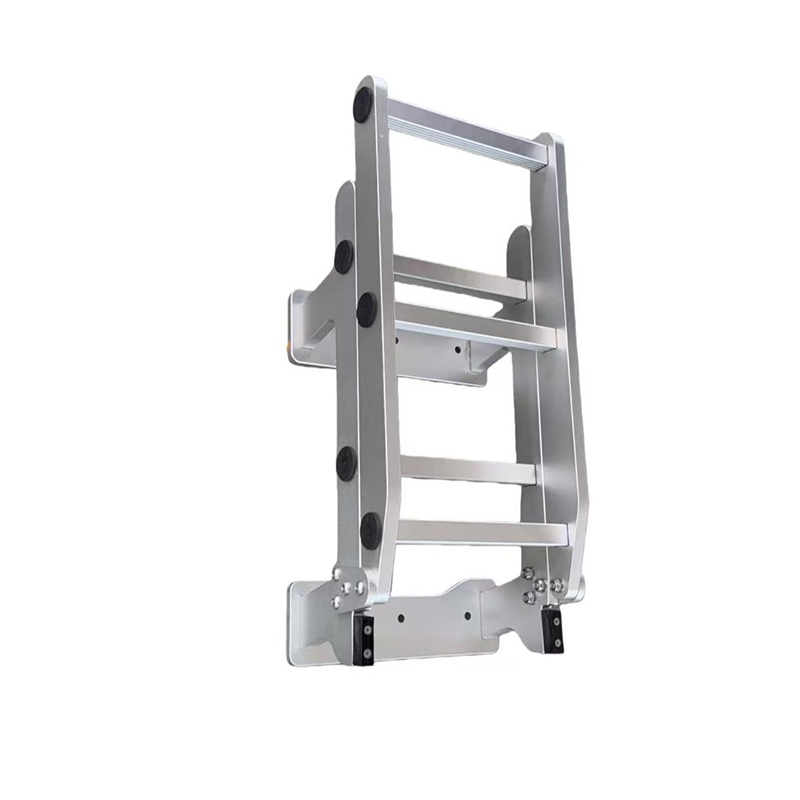 Aluminum Alloy Boarding Ladder for Side and Rear Fire TrucksAluminum alloy side/rear boarding ladder with 304 stainless steel fasteners and customizable L, L1, L2 dimensions; suited to compact fire truck access layouts.View Product →
On vehicles where a ladder is stored high on the body, the rail and the ladder rack brackets often share the same mounting line. Check the two interfaces together before drilling, because a rack bracket moved by 20 mm can leave a handrail sitting where no hand naturally falls.
What to Put in the Purchase Specification
- Material and temper, for example 6061-T6 extrusion or coated carbon steel, with the grade written out rather than described as "aluminium".
- Outside diameter and wall thickness with a tolerance, not a nominal figure alone.
- Finish: mill, anodised, powder-coated or painted, including the colour reference for visible exterior rails.
- Bracket type, spacing and the load direction each bracket must resist.
- Fastener grade and any isolating washer or gasket between dissimilar metals.
- Standoff distance and the minimum clear grip space behind the rail.
- The load case and how it will be verified — a static pull test at mid-span is quick, repeatable and worth writing into the order.
Because these parts are cut, bent, welded and finished in-house, a specification written this tightly can be quoted and produced without a round of clarification emails; the factory workflow behind them is outlined on our manufacturing page.
Frequently Asked Questions
Should the handrail be welded to the body or bolted on?
Bolt it on wherever the vehicle will be repaired in the field, and weld only where the joint is hidden inside a structure and protected from weather. A bolted rail can be re-tightened or swapped in an hour at the station.
Why do aluminium rails sometimes loosen at the bracket?
Two usual causes: steel fasteners fitted directly against aluminium, which corrodes and loses preload, and brackets spaced too widely so the rail flexes and works the bolts loose over thousands of kilometres.
How thick should the handrail tube be?
For a typical exterior rail, 2 mm to 3 mm of aluminium wall or 1.5 mm to 2.5 mm of steel wall is a sensible range. Go thicker only if the span between brackets is unusually long, since extra wall thickness also adds weight high on the vehicle.
Can a handrail be added to an apparatus already in service?
Yes. Retrofit rails are normally bolt-on with a backing plate behind the panel to spread the load. Confirm what sits behind the mounting point first — wiring and air lines are frequently routed exactly where a bracket wants to land.
The Short Version
A fire truck safety handrail earns its place through geometry and fixing quality, not through the name of the material. Choose the diameter that a gloved hand can hold, the wall thickness that resists a jolt without denting, and the bracket and washer combination that keeps the joint tight after two winters of road salt.
Get those three decisions right and the rail quietly does its job on every call. Get them wrong and the first person to find out will be the one stepping down in the rain, in the dark, with both hands full.
News
-
-
Every firefighter has opened a compartment door after a rough response only to find nozzles, webbing, and wrenches piled on top of each other. In gloves and low light, with the pump running, that is ...
READ MORE -
Two pumpers of the same model can feel like two different trucks on the same call. On the first, a firefighter reaches into a compartment, releases one latch with a gloved hand, and pulls a tray far ...
READ MORE -
Specification meetings usually park the ladder rack near the bottom of the option sheet, a few lines above the license plate bracket. That is also why ladder racks become the complaint in year three:...
READ MORE -
A builder fitting out a pumper asks one question before ordering anything: fixed deck monitor or portable cannon? The answer should follow the attack, not the catalog. A fire hose cannon earns its p...
READ MORE -
It is 02:40, the truck is backed into the bay, and the rear compartment shutter stops about thirty centimetres up and will not move. Inside are the rescue tools for the next call. That is the moment ...
READ MORE
Hey! Interested in staying in the loop? Sign up for our updates.
WE WON'T SPAM YOU, PINKY PROMISE.

Tianchang Jinlv Fire Equipment Co., Ltd.
Copyright © Tianchang Jinlv Fire Equipment Co., Ltd. All rights reserved. Custom Fire Truck Equipment Supplier Fire Apparatus Parts Factory
