en
 English
 русский
 Español
 عربى

A builder fitting out a pumper asks one question before ordering anything: fixed deck monitor or portable cannon? The answer should follow the attack, not the catalog. A fire hose cannon earns its place only when you know the flow needed at the nozzle, the inlet your hose can actually feed, and who will be standing behind it when the stream goes to full pressure. Get those three right and the rest — swing range, mounting pattern, seal material — is detail work. Get them wrong and the monitor stays folded until the fire is already too large.
What a Fire Hose Cannon Is and Where It Sits on the Apparatus
A fire hose cannon — also called a water cannon, deck gun or monitor — is a high-capacity water delivery assembly that takes flow from a hose line, a pump discharge or a piped riser and throws it far enough that nobody has to fight the stream by hand. It is not a branch nozzle. It has its own inlet, swivel joint, control handle and outlet, and its job is to put the reaction force of a large stream into a mounting instead of into a firefighter's shoulders.
The term covers two different products. A fixed deck cannon is bolted through a turret or flange on the roof of a pumper, an ARFF vehicle or a skid unit. A mobile cannon, often sold as a portable or ground monitor, sits on a base, a tripod or a fold-out leg set and can be carried to a hydrant, a pier edge or a stair landing where no turret exists.
Both work the same way. Water enters the inlet, passes a swivel joint that allows horizontal sweep and vertical elevation, and leaves through a nozzle that sets the pattern. Common inlets are 2.5, 3 and 4 inch, with flanged connections on larger deck units. Rated flow runs from roughly 1,000 L/min on a portable unit to 2,500–3,000 L/min on a fixed monitor at about 8 bar at the nozzle. Throw distance is what most officers judge the purchase on, and throw depends on nozzle pressure and stream shape far more than on inlet size.
For apparatus with a permanent turret position, the fixed units in our fire hose cannon range use a flanged or threaded base with a handwheel-controlled swivel, so the operator can sweep and elevate without leaving the platform.
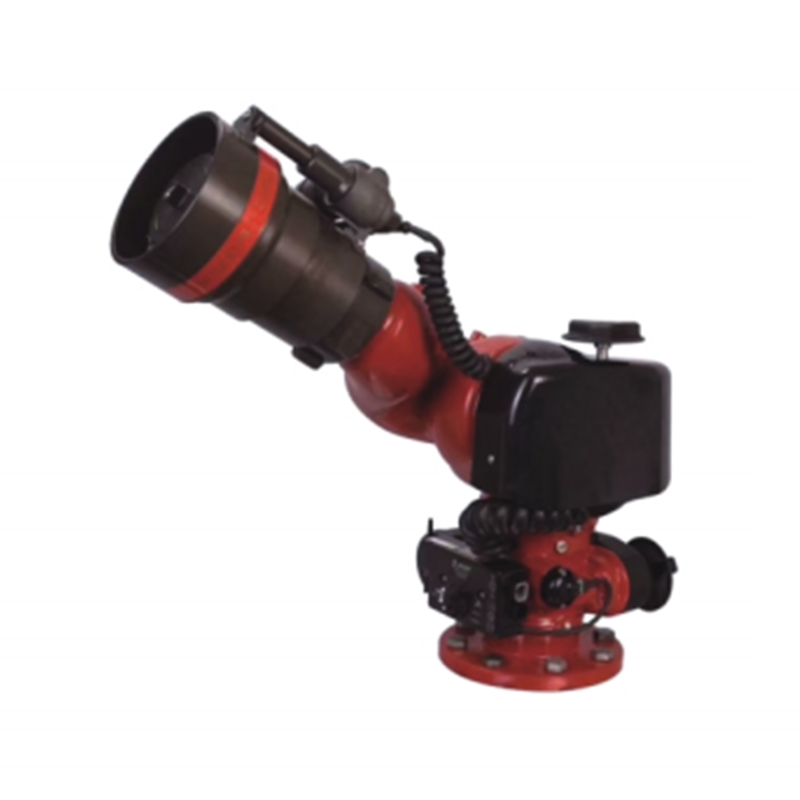 Fixed Fire Hose Cannon for Permanent Turret MountingFixed fire monitor, aluminum alloy body, adjustable flow, straight stream and spray modes, horizontal rotation and vertical tilt; suits permanent vehicle mounting.View Product →
Fixed or Mobile: Match the Cannon to the Attack
If the cannon will always work from the same vehicle, choose fixed. If the water source moves — hydrant to hydrant, pier to pier, floor to floor — choose mobile. That single question settles most of the specification, because mounting, inlet size and reaction-force handling all follow from it.
| Criterion | Fixed deck cannon | Mobile fire hose cannon |
|---|---|---|
| Mounting | Bolted to turret, roof flange or skid | Ground base, tripod or fold-out legs |
| Typical inlet | 3 inch, 4 inch or flanged | 2.5 or 3 inch hose coupling |
| Working flow | About 1,500–3,000 L/min | About 800–1,800 L/min |
| Reaction force | Carried by the vehicle chassis | Must be staked, weighted or footed |
| Crew needed | One operator at the turret | Two people to carry and set |
| Best use | Vehicle attack, ARFF, industrial plant | Hydrant, dock, stairwell, temporary position |
A mobile cannon also suits jobs where the pump discharge is the only reliable feed: the base can be set within hose length of the appliance and moved as the fire travels. The trade-off is stability. A 1,500 L/min stream on a light tripod will walk across concrete unless the base is weighted or staked, and anything above roughly 2,000 L/min should not be left running unattended. The portable units in our range are sized for a two-person carry and use a fold-out leg set rather than a single spike, which keeps them steady on concrete as well as grass.
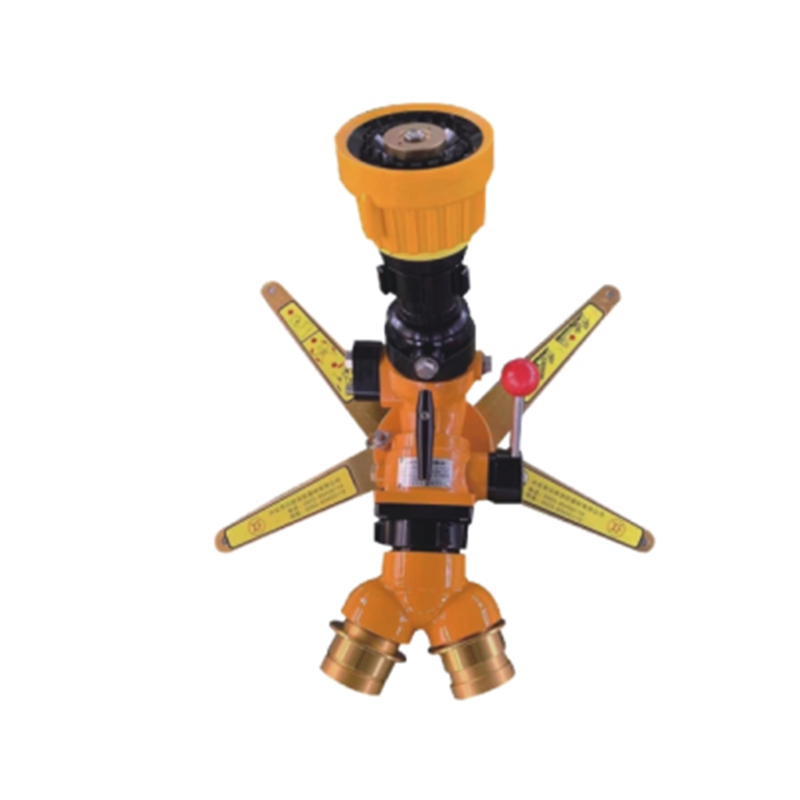 Mobile Firefighting Water Cannon for Portable DeploymentAluminum alloy mobile monitor with adjustable flow, straight stream and spray modes, horizontal rotation, vertical tilt; portable design suits moving between water sources.View Product →
Specifications That Decide Real-World Performance
Two cannons with the same inlet can behave completely differently on the fireground. These are the figures worth writing into a purchase specification, and the tolerances worth checking on the sample.
Inlet size and hose compatibility
A 2.5 inch inlet fed by a single 2.5 inch line will never deliver 2,500 L/min, whatever the cannon is rated for; friction loss in the hose sets the ceiling first. Above about 1,500 L/min, plan on a 3 inch or larger feed, or two lines into a siamese connection. Confirm the thread standard before ordering: BSP, NPT and Storz couplings are not interchangeable, and an adapter changes the stowed length.
Nozzle pairing
The body sets flow; the nozzle sets the stream. A fog tip gives a wide protective curtain at shorter throw, a straight-stream tip reaches furthest, and a multifunctional tip changes pattern at the nozzle without tools. Most complaints about a weak cannon trace back to a mismatched nozzle rather than to the pump. Our guide to choosing fire fighting nozzles covers pattern, pressure and flow for different duties, and the multifunctional units below combine fog, straight stream and shut-off in one tip.
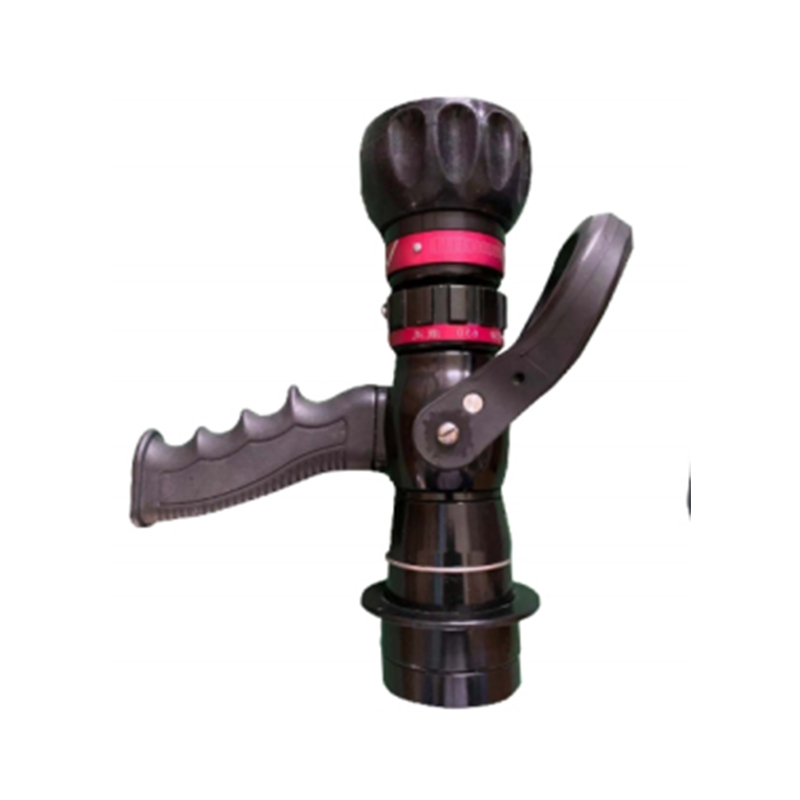 Multifunctional Fire-Fighting Nozzle for Fire Truck UseMultifunctional fire-fighting nozzle with straight stream, narrow fog, wide fog and flush modes; aluminum or brass body, trigger switch, rotating inlet, 40-65 mm inlets.View Product →
Swing, elevation and stowage
- 360-degree horizontal sweep is normal on deck units; portable mounts often stop at 180 to 270 degrees, which matters when the wind shifts.
- An elevation range of roughly -15 to +75 degrees covers ground attack and elevated streams from one position.
- Detent or friction locks must hold the stream after the operator steps back; a cannon that creeps under pressure loses the seat of the fire.
- Check folded height against garage-door clearance on the apparatus, not just the working height.
Materials, seals and reaction force
Bodies are usually cast or fabricated in aluminium alloy with stainless steel or bronze internals and NBR or EPDM seals. Near the coast or in heavy industry, ask for salt-spray and corrosion data, because an aluminium body with a mild steel handle will seize within a season. Reaction force is the figure most often left out: a 2,000 L/min stream at 8 bar produces several hundred newtons, and the mounting flange, not the cannon, has to carry it.
Sourcing Checks That Prevent Field Failures
Most failures in service are not dramatic. They are a swivel that drips, a handle that binds, or a base plate that will not sit flat on a turret. All three are caught at the sample stage.
- Measure the mounting flange or base pattern against your turret drawing, including hole pitch and flatness; a 1 mm twist shows up as a stream that will not lock off.
- Ask for a hydrostatic test record at 1.5 times the rated working pressure, held long enough to reveal seal weep rather than just a burst figure.
- Confirm thread type and coupling standard in writing, and check the supplied adapter against your hose stock.
- Match the seal compound to the foam concentrate or seawater you actually use; standard NBR is not right for every foam.
- Check that handwheels, swivel seals and nozzle tips are available as spare parts, because those are the items that wear.
- Review coating and salt-spray hours if the apparatus works near the coast or in heavy industry.
Production control is where these checks either hold or drift. Our factory runs a documented process from raw material intake to final delivery under a GB/T19001-2016 quality system, with inspection at assembly and before packing, so the tolerance approved on the sample is the tolerance shipped in the batch. That sequence is described on the factory page.
Frequently Asked Questions
Can a mobile fire hose cannon run from a 2.5 inch line?
Yes, and that is the usual arrangement. One 2.5 inch line comfortably supports about 800 to 1,500 L/min, depending on length and pump pressure. Above that, add a second line through a siamese connection or step up to a 3 inch feed.
What flow should a deck cannon deliver?
For structural firefighting from a pumper, 1,500 to 2,000 L/min at 7 to 8 bar at the nozzle is a practical target. Specify flow at the nozzle, not at the pump, and state the inlet pressure you can actually supply.
How often should swivel seals be replaced?
Inspect annually and replace when the joint weeps at rest or the sweep turns stiff. Foam concentrate, seawater and long storage shorten the interval. One seal kit per apparatus avoids taking a monitor out of service for a low-cost part.
Does the cannon need its own nozzle?
Yes. Body and nozzle are separate components with separate ratings. A cannon rated at 2,500 L/min will not reach it through an undersized fog tip, and an oversized straight-stream tip will overload a portable base with reaction force.
Specify the cannon around the stream you need at the fire, then let the hardware follow: an inlet your hose can feed, a nozzle that matches the duty, and a mounting that carries reaction force without creeping. A fixed deck cannon is the simpler answer when the vehicle is always the platform; a mobile cannon is the answer when the water source moves. Either way, the difference between a monitor that works for a decade and one that drips in its second season is usually measured in millimetres at the mounting flange and in the seal compound chosen at order. If you are matching a cannon to an existing turret, send the base drawing and the intended flow, and the fit can be confirmed before the unit is built.